Every enterprise that has looked seriously at stablecoin settlement has hit the same wall. Tempo gives you sub-second finality, sub-cent fees, and protocol-level compliance controls. All good. Then someone in the room asks: "Can our competitors see how much we're settling with each merchant?"
On any public blockchain, the answer is yes. Settlement volumes, payroll amounts, treasury movements between entities, counterparty relationships. All of it sits on a public ledger that anyone with an internet connection can read.
This is why most institutional stablecoin projects stall. Not because the rails don't work. Because the rails are transparent.
Tempo Zones fix this. REM builds custom Zones for institutions that need private stablecoin settlement deployed to their specific requirements.
What Zones give you
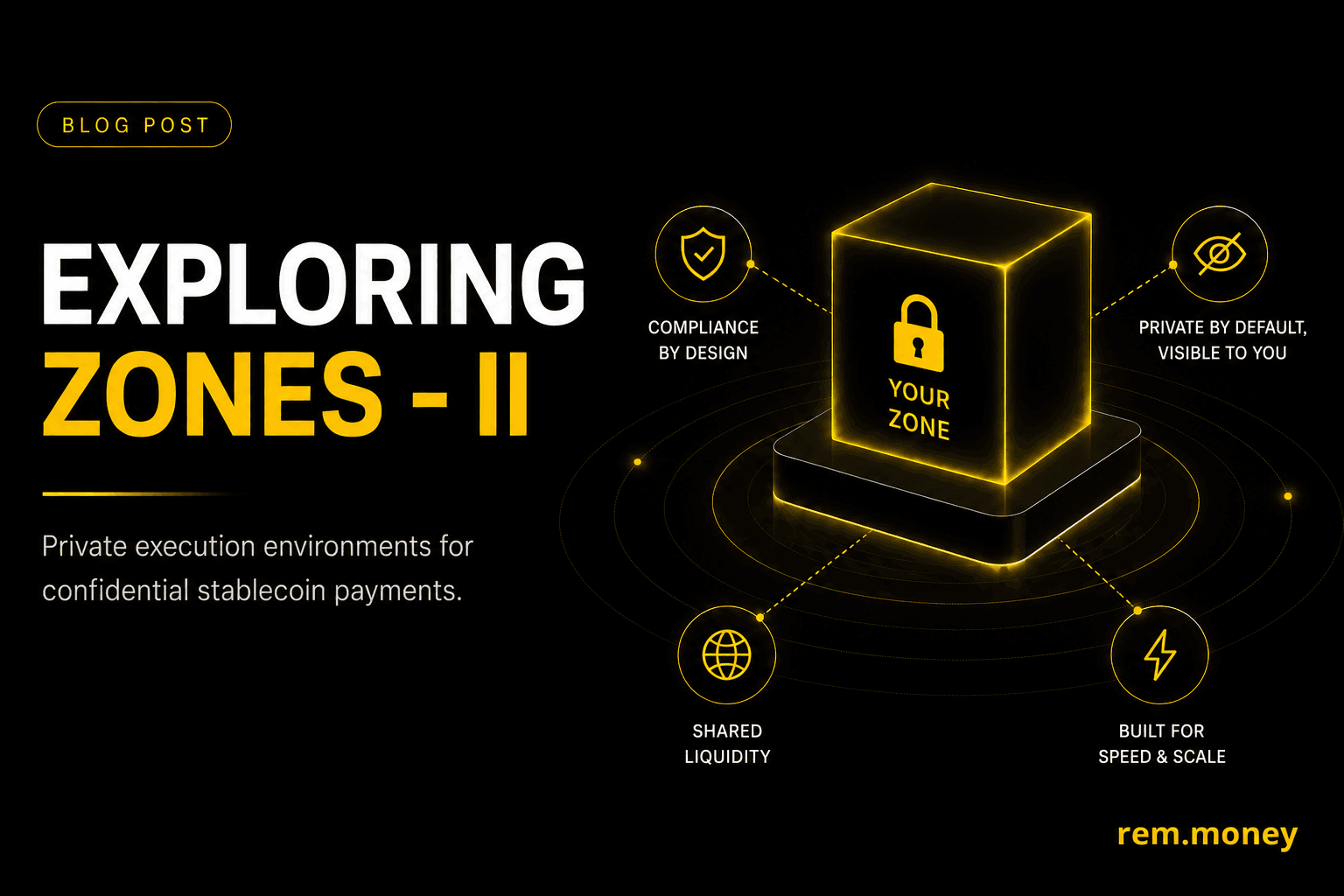
A Zone is a private execution environment: an EVM-compatible chain running parallel to Tempo's mainnet where all transactions are invisible to outsiders. Funds enter and leave through a smart contract on mainnet. Inside, only the Zone operator (usually you, or a party you trust) can see activity.
The operator sees everything inside the Zone, so audit trails, regulatory reporting, and transaction monitoring work the way your compliance team expects. Nobody outside the Zone can see transaction details, counterparties, or volumes. Same idea as part 1: privacy from the market, visibility for compliance.
Unlike private permissioned ledgers that isolate your assets, Zones stay connected to Tempo mainnet. Users can withdraw, swap on Tempo's native DEX, and redeposit without exposing internal addresses. No fragmented pools. No custom integrations to reach the broader market.
Issuer-defined policies under TIP-403 (allowlists, blocklists, freeze capabilities) propagate automatically across every Zone. When a stablecoin issuer updates a blocklist, every Zone enforces the change immediately. Protocol-enforced, not manual.
Real institutions are already building on Zones
Howard Hughes Holdings (NYSE: HHH) is building onchain financial verification on Tempo. As a public company, their construction budgets, lease terms, and development economics are commercially sensitive. They're recording general ledger transactions on Tempo for real-time reconciliation and audit, shifting from month-end batch processing to continuous verification. Zones keep the financial data private while giving auditors full access.
Coastal Financial Corporation (Nasdaq: CCB) is building cross-border stablecoin settlement corridors. They're a regulated sponsor bank powering fintech products through their CCBX division. Their approach: keep existing KYC/AML screening in place, replace only the settlement layer. Stablecoins on Tempo instead of correspondent banking chains. Zones keep settlement volumes visible only to counterparties and regulators.
Both followed the same principle: don't rebuild the compliance stack. Replace the settlement rail underneath it.
Five use cases we're building around
Cross-border settlement corridors
The one we think about most. A bank in one country needs to settle with a bank or PSP in another. Today that means correspondent banking: multiple intermediaries, multi-day settlement, pre-funded accounts, fees at every hop.
With a custom Zone, both institutions transact inside a shared private environment. The sending bank converts to stablecoins, transfers to the receiver inside the Zone, and the receiver redeems to local fiat. Minutes instead of days, and settlement volumes stay between the two parties.
On our side, we configure these Zones with KYC allowlists matching the onboarded counterparties and jurisdiction-specific transaction policies, then plug them into our multilateral netting engine. Obligations get netted before final transfer. Less capital in transit, fewer transactions on the wire.
Merchant settlement
PSPs settling with hundreds of merchants leak commercially sensitive data on public chains. Per-merchant volumes, average ticket sizes, seasonal patterns. A restaurant chain doesn't want competitors seeing daily revenue. A SaaS company doesn't want investors tracking settlement before quarterly reports.
We build Zones where each merchant sees their own settlement data, the PSP sees everything as operator, and the public sees nothing. Automated settlement scheduling, structured memo fields for ERP reconciliation, and netting across the full merchant book.
Treasury operations
Corporations moving money between entities (intercompany transfers, liquidity rebalancing, subsidiary funding) reveal capital allocation strategy on public chains. For complex entity structures we build multi-Zone architectures: separate Zones for separate business units where needed, with liquidity flowing between them through mainnet. Intercompany settlements reduce to net positions rather than gross transfers.
Payroll
Employee compensation is some of the most sensitive data a company handles. On a public chain, every payment amount is visible. We build payroll Zones with employee allowlists, scheduled batch payments, and multi-currency support for cross-border contractors. REM's compliance engine attaches FATF-compliant travel rule data to each payment for the relevant jurisdiction.
Agentic payments
This one is early but it matters. AI agents making autonomous payments generate high-frequency patterns that reveal which services a company uses, how often, and at what cost. Inside a Zone, those patterns stay private. A lot of infrastructure for agent wallet with spend limits, service allowlists, and automated settlement between the agent's Zone and service providers is being built, all connected to x402 payment protocols and agentic payments SDK.
How REM delivers custom Zones
We handle the full lifecycle. We scope your compliance requirements, counterparty structure, and operational workflow, then design a Zone (or multi-Zone) architecture that matches. We configure and launch it with your specific allowlists, transaction policies, token enablement, and operator setup.
Custom Zones plug into REM's clearing layer for multilateral netting, IVMS 101 compliance, and cross-border settlement orchestration. You can run the Zone yourself or have REM operate it under SLAs for liveness and throughput. Either model, we handle monitoring, failover, and ongoing configuration.
What's next
Zones are on testnet now, with phased production deployments planned through Q2-Q3 2026. The protocol software is fully open-source. Conduit is supporting Zone launches, with more infrastructure providers expected.
If you're evaluating stablecoin infrastructure for payments, settlement, or treasury, and transaction privacy is a requirement, reach out at hi@rem.money or book a call about what a custom Zone looks like for your use case.