Crypto loves solving privacy with more cryptography. Zero-knowledge proofs. Fully homomorphic encryption. Multi-party computation. Impressive on a whiteboard, mostly unusable if you actually need to ship a payment product this quarter.
We build stablecoin settlement infrastructure for banks, PSPs, and fintechs. Our clients have one simple requirement: their transaction data cannot be public. So we sat down and evaluated everything on the market. Here's the honest scorecard.
Pseudonymity is not privacy
Ethereum, Solana, every public L1 hands you a pseudonymous address instead of a name. That used to feel like enough. It isn't. Chainalysis, TRM Labs, and Elliptic have built entire businesses around linking wallets to identities. Once someone maps your treasury address, they can see every dollar you've moved and every counterparty you've settled with, going back to your first transaction. Retroactively. Permanently.
For an institution running payroll or settling with merchants, that's not a theoretical risk. It's a guarantee that your financial data becomes public eventually. Dead on arrival for regulated institutions.
ZK privacy chains solve the wrong problem
The math is sound. The engineering isn't ready. ZK privacy systems need specialised wallets, force users to manage encrypted state, and create compliance gaps regulators won't tolerate. When a regulator asks for records, "the user holds the decryption key and we can't access it" is not an acceptable answer from a bank.
Some ZK architectures are working on selective disclosure through viewing keys and compliance proofs. The work is promising. It's also two to three years from being enterprise-deployable, and that's being generous.
Private permissioned ledgers are islands
The Hyperledger and R3 Corda era tried this. Spin up your own private blockchain. Full privacy, full control. Also full isolation. Your assets are trapped. Want to swap USDC for EURC? Build your own liquidity pool. Want to settle with a counterparty on a different private chain? Custom integration every time. You end up with a network that does one thing for one set of counterparties and can't do anything else.
That's the approach that taught the industry a lesson the hard way: privacy without interoperability isn't worth much.
Zones are the boring answer that works
Again, that's a compliment.
Zones took a different path. Instead of exotic cryptography or network isolation, the team built something that looks like the financial system institutions already trust, but runs on stablecoin rails.
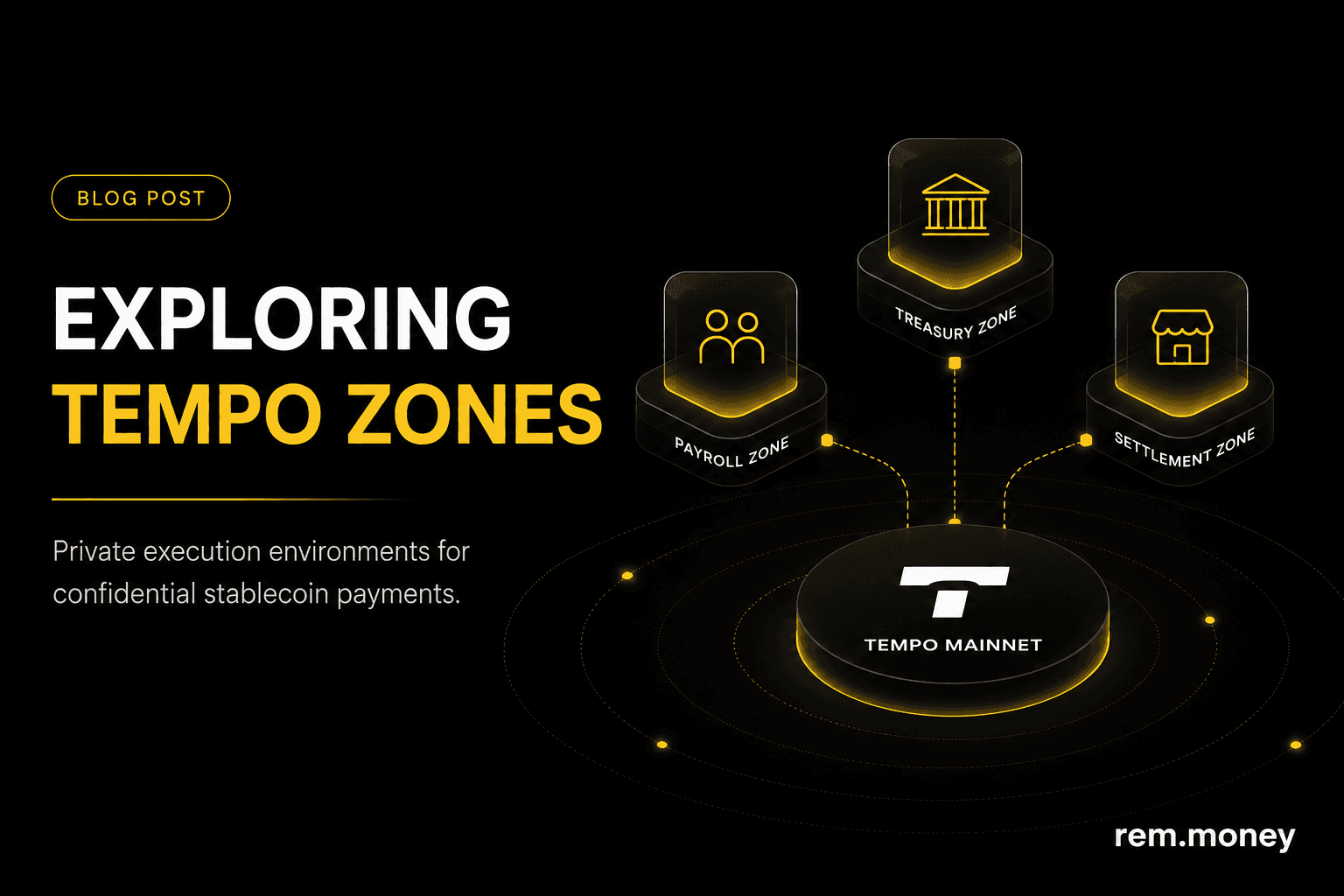
A Zone is a private chain running parallel to Tempo's public mainnet. Transactions inside are invisible to the outside world. Tokens stay liquid through mainnet's shared pools. Compliance controls (allowlists, blocklists, freeze) propagate automatically from the token issuer across every Zone. Standard wallets work. No specialised tooling. Sub-second finality.
The Zone operator, usually the institution itself, can see everything inside. That's the part that makes cryptography purists uncomfortable. It's also the part that makes CFOs relax. They don't need privacy from their own compliance team. They need privacy from competitors and from anyone else who shouldn't be watching their cash flows.
The part that actually matters, though: liquidity isn't trapped. Any user inside a Zone can withdraw to mainnet, swap on Tempo's native DEX, and deposit into another Zone. No per-Zone pools, no wrapped tokens, no bridges. Private permissioned ledgers never solved this. They gave you privacy by cutting you off from everything else. Zones don't.
The honest limitations
There are no in-Zone swaps; you round-trip through mainnet. No direct Zone-to-Zone transfers either, same pattern. One operator per Zone, so if the operator goes down, transactions stall (funds stay safe on L1). And the operator sees everything inside. This is a trusted model, not a trustless one.
Those are real constraints. For institutions whose threat model is "the public can't see our settlement data" rather than "nobody can see our settlement data, not even our own infrastructure," they're the right tradeoffs. For the cypherpunk ideal of zero trust, they're not. We're fine with that.
What REM does with all of this
We build custom Zones for clients.
Your counterparties, your jurisdictions, your compliance framework, your operational workflow. We deploy a Zone configured for exactly that. Then we wire it into multilateral netting to compress settlement volume, IVMS 101 travel rule data for cross-border payments, and settlement orchestration between institutions.
You can run the Zone yourself or have REM operate it. Either way, you get private stablecoin settlement with institutional-grade compliance, without building the infrastructure from scratch.
Zones handle privacy. REM handles everything between you and your counterparties.
Reach out at hi@rem.money or book a call.